Embodied Voice & Expression
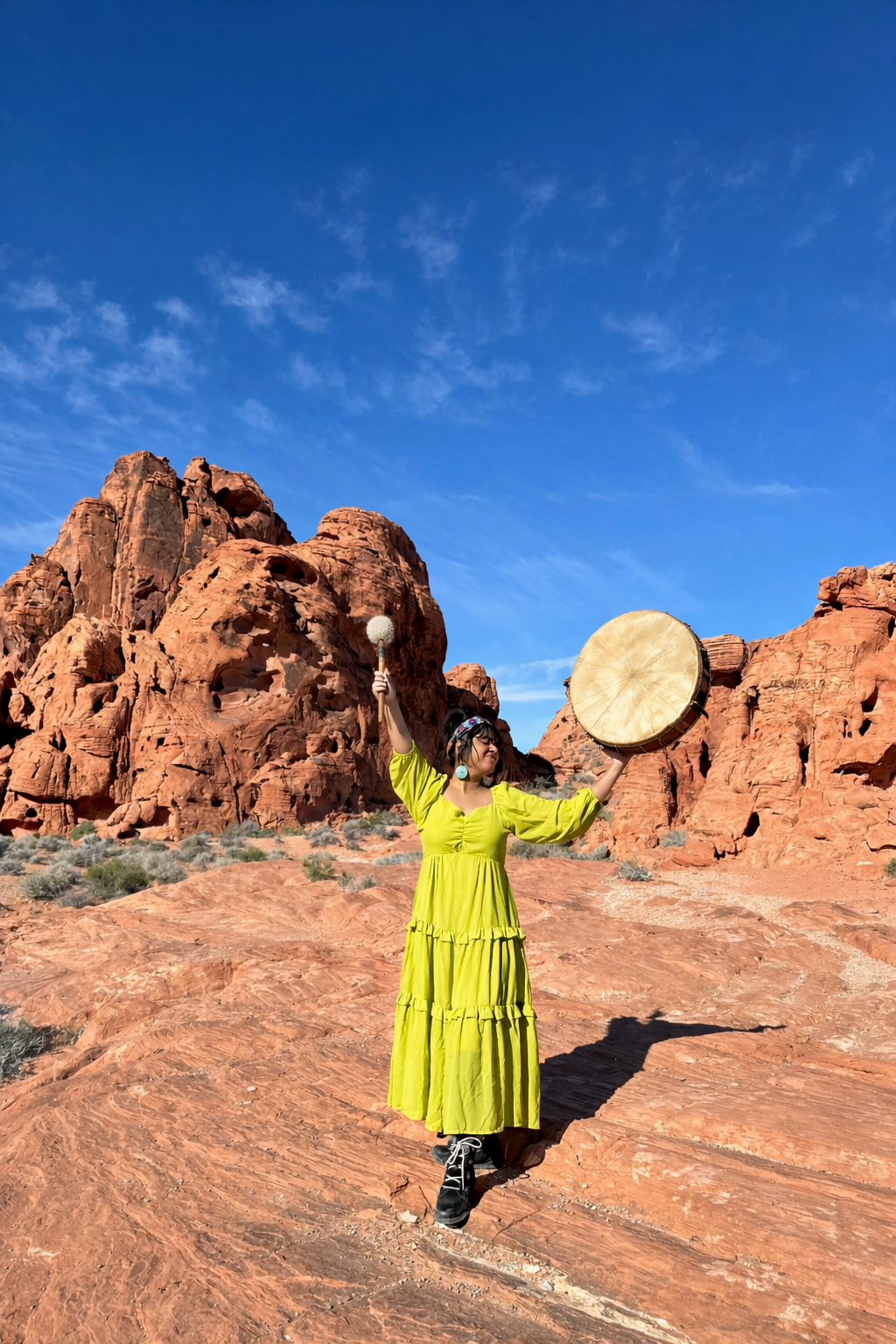
A 1:1 Trauma-Informed Somatic Voice & Sound Healing Pathway for Expression, Nervous System Regulation & Wholeness
Embodied Voice & Expression is a trauma-informed 1:1 offering that supports you in gently reconnecting with your authentic voice as a pathway to nervous system regulation, restored inner flow, expanded vocal expression and creativity, embodied confidence, emotional wellbeing, self-love, and spiritual integration.
Sessions integrate Nāda Yoga principles, vocal yoga–inspired practices, Somatic Experiencing–informed somatic awareness, intuitive sound, movement, breath-work and Indian rāga–based vocal practices to support a gradual, nervous-system–aware reconnection with voice.
Your voice is not just sound.
It is how your body meets life.
It reflects how safe you feel to exist, to take up space, to receive, to express truth, to soften, to love.
For many people, the voice carries more than personal experience.
It carries family patterns, cultural conditioning, and generational survival strategies that shaped how expression was allowed—or restricted.
This work is not about performance.
It is about presence.

Why the Voice Matters
Do you notice a tremor when a microphone is placed in your hand?
Do you feel the urge to sing, move, or dance fully—yet sense something inside holding you back?
Do you notice your jaw tightening when words go unsaid, or a familiar knot forming in your stomach when expression feels unsafe?
These are not random reactions.
They are ways the body remembers what it learned about expression, safety, and belonging.
The voice sits at the intersection of breath, emotion, and the nervous system. When expression is consistently held back—through silence, people-pleasing, or over-control—the body adapts. Over time, this can show up as stress, reactivity, fatigue, difficulty resting, or a sense of always searching.
Gentle voice and sound practices help restore safety in the body, allowing breath, emotion, and expression to move again.
When the voice softens, the nervous system follows.
The Generational Layer of the Voice
Many people sense that their difficulty with expression didn’t begin with them.
Across generations—especially among women and in collectivist or marginalized cultures—the voice often learned to stay quiet to maintain harmony, suppress emotion, prioritize responsibility over expression, or choose safety over authenticity.
These adaptations were intelligent.
They helped families survive.
But what once protected us can later become a source of stress, disconnection, and inner tension.
In this work, we gently explore how your voice learned to adapt across generations—not through analysis, but through embodied listening. Nothing is forced. Nothing is blamed. The body is allowed to unwind what it no longer needs to carry.
Why I Feel Called to This Work
This work is deeply personal for me.
I grew up in a South Asian family where I witnessed the women before me—my mother, my grandmother—hold so much inside. Their voices were present, yet often unheard. Their needs came second. Emotional and expressive space was limited.
I inherited many of these patterns without realizing it.
As a child, I was drawn to singing and sound. But as I grew older, I chose a different path—science and technology—shaped by responsibility, performance, and people-pleasing. Expression slowly became something to manage rather than inhabit.
I have lived the cost of not expressing.
When the voice is held back, the body carries it. Chronic stress builds. The nervous system stays alert—scanning, bracing, searching for the next thing.
Through years of somatic work, sound practices, and embodied inquiry, I didn’t just “find my voice”—I found my frequency.
As my relationship with my voice and body deepened, my health began to shift. My sleep improved. My nervous system softened. The constant inner searching—the need to strive, fix, or look for the next best thing—quieted.
I became less reactive. Anger and irritation softened. There was more presence, more ease, and a deeper sense of inner support.
This lived transformation is why I hold this work—not as a technique or method, but as a space of safety and remembering, where the voice is gently invited home.

Voice Healing as Nervous System Regulation
From a nervous-system perspective, sound and voice are powerful regulators.
Gentle vocalization, humming, and toning stimulate the vagus nerve and support the body’s natural capacity to rest, digest, and restore. Unlike cognitive approaches that work from the top down, voice healing works from the inside out—meeting stress where it actually lives.
Many people experience:
Improved sleep
Reduced anxiety and reactivity
Greater emotional regulation
A quieter inner landscape
A deeper sense of grounded presence
Not because anything is forced or “fixed,” but because the nervous system no longer needs to hold tension—allowing vocal ease, creativity, and embodied confidence to emerge naturally.
Voice Healing as Self-Love
Self-love is not an idea.
It is a felt experience of safety in one’s own body.
When the voice is welcomed—without judgment or pressure—you begin to listen inwardly rather than override sensation. You learn to meet emotion with presence instead of control or avoidance.
In this way, voice healing becomes an act of self-devotion: a practice of being with yourself exactly as you are, and allowing embodied confidence to arise from self-trust rather than self-correction.
Restoring Inner Balance & Flow
Many people come to this work sensing an inner imbalance—not as something wrong, but as something unresolved and often inherited. These patterns are frequently shaped by family roles, cultural conditioning, and generational expectations around expression, responsibility, and emotional safety.
Some feel deeply intuitive, emotional, and relational, yet struggle with grounding, clarity, or containment. Others feel highly functional, responsible, and structured, yet disconnected from softness, receptivity, and flow.
In this work, these patterns are recognized as intelligent adaptations shaped by family roles, cultural expectations, and survival needs.
Through embodied voice practices and somatic coaching and SE principles, we gently support the integration of inner polarities—flow and structure, receptivity and clarity, softness and strength with a trauma informed lens.
As inner balance is restored, many people experience greater creative flow, clearer expression, and the confidence to take up space without forcing or performing. The voice becomes a bridge—allowing expression to soften without collapsing, and strength to emerge without effort.
Voice Healing & Spiritual Growth
Across spiritual traditions, sound has always been a bridge to the sacred.
In this work, spirituality is not imposed. It arises naturally through presence. As the nervous system settles and the voice finds ease, many people experience a deeper connection to intuition, a softening of striving, and a deeper access to devotion, prayer, or meditation.
The voice becomes not something you use, but something you listen through.
While this work can support people of all genders, my practice is primarily oriented toward working with women, in recognition of the unique cultural, generational, and nervous-system patterns many women carry around voice, expression, and self-worth
What sessions may Include
Somatic Experiencing–informed tracking and nervous system awareness, supporting safety, pacing, and choice
Voice exploration through gentle vocal toning, humming, and intuitive sound
Indian rāga–based vocal practices, exploring sound, vibration, and their relationship to the body’s energetic centers, chanting practices and mantra (if open to it)
Breath, rhythm, drumming, musical instruments and gentle movement to support embodiment and expression
Nature-based elements for sensory grounding and co-regulation as appropriate
Spacious integration, rest, and reflection to support meaning-making and nervous system settling
Who This Work Is For
This offering is especially supportive for women and feminine-centered beings who:
Feel blockage in throat or heart chakra
Want to express, speak, sing, or create more freely and embody confidence
Feel pressure to perform, or burn out from people-pleasing
Feel stressed, reactive, or chronically “on”
Struggle to express needs, emotions, or truth
Sense generational or cultural silencing in the body
Feel disconnected from the flow, pleasure
Feel tension between softness and strength
Long to rest, receive, and be supported

A Trauma-Informed Space
This work is held with care, consent, and respect for the nervous system.
This work is:
Consent-based and choice-led, with attention to nervous system titration
Slow, attuned, and responsive, rather than directive or forceful
Rooted in safety and regulation, not emotional catharsis or pushing through
Inclusive of rest, silence, sensation, and emotion
Guided by the body’s wisdom — your body sets the pace
There is no expectation to perform, relive, or “fix” anything. We listen for what is ready to emerge, and we honor what is not.
Session Details
Format: 1:1 private sessions catered to your needs,
Length: Between 60-90 minutes varies based on clients journey on that day
Location: Both in-person and Zoom options available.
Entry Options & Frequency:
Embodied Voice & Expression Mentorship
$298 / month
• 2 private sessions per month
• Each session is 60–90 minutes
Minimum commitment: 3 months
Recommended journey: 6–8 months, allowing the work to unfold with consistency and integration. Participants may continue beyond this period as the journey deepens.
Full Journey Option
16 session package-$2300 (with payment plan options)
What This Work Is Not
To support clarity and safety, it’s important to name what this work does not offer.
This work is not:
Psychotherapy or mental health treatment
A substitute for medical, psychological, or psychiatric care
Diagnostic in nature
Focused on reliving or processing trauma through catharsis
About correcting, training, or forcing the voice or body
This is somatic, sound-based, and experiential guidance, offered within the scope of trauma-informed, body-aware practice.